Showing posts with label Rating the Underrated. Show all posts

Monday, July 6, 2015

Rating the Underrated: Why "Crash" Actually Deserved Best Picture


Don Cheadle is so sad and confused about why people hate this movie.
Perspective is an interesting thing, especially in an artistic context. What seemed brilliant once might, upon a future viewing, seem thoroughly disappointing as we grow as viewers and the medium evolves. Similarly, I can't even count the number of things which have been deemed "ahead of their time," and which have only received their deserved acclaim and recognition years after their initial release. This is perhaps most apparent when one looks at awards ceremonies of years past. The Oscars are well-known to be problematic, and their most reliable function is probably to serve as an indication of what people were responding to at a given point in history. In 1976, the country was still feeling betrayed by the government they once trusted in light of Watergate, and it showed in that year's Oscar ceremony. Films which are now considered among the best films ever made like Taxi Driver (about a dangerous psychopath who ends up becoming a national hero), Network (about, among other things, corruption in the media and its willingness to exploit its broadcast for ratings), and All the President's Men (about the Watergate scandal itself), all lost to the feel-good sports movie Rocky. Many people are still surprised by this decision, but it makes sense. Audiences were responding far more to the story of an inherently good underdog achieving success. It was uplifting at a time that the country needed it. Other times, historical context can't be used as an excuse and the Oscar decisions just seem baffling. At the 14th Academy Awards, for example, the rather forgettable How Green Was My Valley took home the award for Best Picture over other films which have aged with much more grace-- such as Alfred Hitchcock's Suspicion, the noir gem The Maltese Falcon, and a little film called Citizen Kane that is generally considered to be okay.

Spoiler alert: it turns out that the Maltese Falcon was just a sled.

There has often been debate about whether or not films deserve the awards that they receive, and as time goes on a few movies are consistently mentioned as undeserved Best Picture winners. One such film that frequently appears in these discussions is Crash, Paul Haggis' ensemble drama which took home the top award at the 78th Academy Awards. Unlike with something like How Green Was My Valley, however, the backlash to this decision was almost immediate. It was a huge upset, and was instantly controversial. For one thing, Crash had not been a major player at most of the other awards, so its Oscar dominance came out of left field. The award was expected to go to Ang Lee's Brokeback Mountain, and it was felt that Crash, while a good film, "stole" the award which it shouldn't have received. But as time goes on, the reaction to the film has proven to be somewhat hostile. Consensus now, by and large, is that it is actually a bad film and its title of Best Picture is seen by many as one of the Academy's greatest oversights. Despite the title of this post (whooo clickbait titles FTW!!!!), I'm not going to try and argue that this was the best film of the year (although, I don't think that honor goes to Brokeback Mountain either-- for me, the best film out of the nominees is Capote) but I do think that the film has received overly harsh criticism. And, especially in light of recent events, deserves a reevaluation. Crash is, in my opinion, a great film and deserves our consideration and respect. As a film dealing with a subject as heavy as race, it may not be the best (that distinction, for me, belongs to Spike Lee's Do the Right Thing) but it earns its place as surprisingly strong supplemental viewing.

If "best film ever made about race" didn't intrigue you, well, Do the Right Thing has Giancarlo Esposito in it. Please watch this movie if you haven't already. It's so important.

First, lets' talk about the film's strengths. For a start, it is unbelievably well-acted. This is a star-studded cast and features some really fantastic performances. Not just that, but many of the performances are the highlights of these actors' careers. Matt Dillon absolutely deserved his Oscar nomination and gives a performance that remains the best of his career. And he's not the only one: Ryan Phillippe, Thandie Newton, Michael Pena, and Terrence Howard all stand out as actors whose performances here cast a new light on their talent. And I think this is an aspect of the film that even its critics would agree on-- these are great performances through and through. I would also argue that the Oscar-winning screenplay deserves merit. While parts of the script have been criticized (which I'll get to in a second) the plot is nonetheless ambitious and well-executed, and individual scenes are certainly well-written, at least in terms of dialogue.

Now here is where we get into the film's criticisms. From reading and hearing peoples' complaints about the film, there are a few problems that stand out. Many people think that the plot's twists and turns are unrealistic and, more pressingly, many take issue with the film's dealings with the subject of race. Which is a fairly big criticism to levy, since that's kind of the entire point of the film. A common criticism is that the film's depictions of racism are caricaturey and preachy-- coming across as holier-than-thou and, again, unrealistic. More troubling, though, is another criticism that the film actually mishandles its depiction of race-- that it provides a too simplistic view of the subject and, by glossing over the intricacies of the issue of racism it provides an incorrect and harmful view of the subject it is supposed to be shedding light on. But I would propose that Crash is a thoughtful consideration of the subject of race--certainly more so than other preachy Oscar-winning films starring Sandra Bullock

I am, of course, referring to Speed.


Let's start with the idea that the plot itself is unrealistic, as that is the easiest to discuss and, in this case, refute. I always find these criticisms boring and, frankly, just incredibly useless when applied to a discussion of film. Obviously, there are times when plot twist can be all too convenient and really test the audience's patience. I find this problem especially glaring when something is "all part of the plan." For example, in films like The Dark Knight or Skyfall (both of which, for the record, I enjoyed greatly) the villains orchestrate plans that work out perfectly in their favor but which have to account for WAY too many variables which are outside of their control. They make such little sense as to be completely impossible. But, even in these cases, I tend to just accept it in the interest of my greater enjoyment of the film. I feel that to hold any dramatic form to only the strictest rules of reality is, frankly, moronic. If films were 100% true to life, they'd be incredibly boring. Are some scenes and premises in films unrealistic in the sense that they probably wouldn't happen in real life? Absolutely. But that's why we're watching a film. And as long as the scenes are handled well and can further the plot and the characters, I'm all for them. In Crash, the many characters end up interacting with one another and, oftentimes, it is for the convenience of the plot, yes. But it is also to make a grander point. Crash may be set in the real world and may focus on real themes, but there is nonetheless a fable-like quality to it that allows for such conveniences. Would the events of the film happen in real life? Perhaps not. But, also, why not? Stranger things have happened. Nothing in this film strikes me as too much to swallow and, as such, I personally dismiss this particular criticism against the film as a whole. Some things might be coincidental, but it is a work of fiction and is allowed to take liberties. The film does not at any point extend beyond what is physically possible. So at no point did I personally find myself taken out of the experience.

Now is where we get into the nitty gritty of the film. Crash does not really follow a typical Aristotelian plot and storyline-- rather it is a general examination of race and racism as it occurs over a few days in Los Angeles. And the most prevalent criticism of the film is its depiction of racism. It's not that these characters are subtly racist, they are REALLY racist, and the film's critics say that the characters come across more as caricatures than as real people. There's the gun store owner who refers to a Muslim character as "Osama." There's the district attorney's wife (Sandra Bullock) who complains that the Hispanic locksmith is going to make copies of their keys and sell them to his gang members. Writer and director Haggis makes no attempts to veil these racist comments and, indeed, they are pretty blatant. But, I have to say, aren't these depictions accurate? While I think most would (hopefully) agree that they would never say such a thing, these are absolutely comments that still exist in our world today. Considering events in the news recently, I don't find anything caricaturey about them at all-- in fact, I find them brutally honest and accurately disturbing. Donald Trump saying that all Mexicans are rapists is not something that would seem out of place in the world of Crash, and none of the depictions of the racists in this film are out of place in the realm of reality.

Frankly, in a world where this man is running for president, you cannot say that ANYTHING is "unrealistic"

The problem in depicting such blatant racism, though, is that often it allows an audience to go "Well, I'm not like them because I'M not racist." But, Haggis avoids this problem admirably as the film goes on. It is no coincidence that a majority of this film's characters are policemen, and it is apt that the film ends with a white police officer shooting an unarmed young black man. While recent tragic events such as those in Ferguson have shed light on the issue of racism and brutality within the police force (which, I will be honest, is partially why I felt compelled to consider this film again and do this writeup) this issue has been present for a shockingly long time. But (spoilers ahead) the policeman who does the shooting is Officer Hansen (Phillippe) who has, until this point, been painted as an undecidedly "not racist." He's supposed to be the good guy. Earlier in the film, he requests for a transfer after his partner's racist remarks, and acts as an advocate during a previous police confrontation. This, again, is a moment that I have seen criticized a lot, the reasoning being that the act by Hansen feels too convenient and uncharacteristic. I disagree-- I feel it is very characteristic and important to show Hansen's own prejudices which come to light with this action. I thought back to the conversation he had with his superior Lt. Dixon (Keith David) when he requested a new partner. Dixon rightly calls Hansen out--is he doing this because he thinks that his partner's comments were truly wrong, or just because they make him uncomfortable? Hansen is not sure how to respond. It's a fantastic scene, and Dixon's speech about having to be a high-ranking black man in a predominantly white and bigoted environment strikes as heartbreakingly true.

"I'm really really not racist, you guys." Officer Hansen

The most overt example of racism in the film is Hansen's partner, Officer John Ryan, played by Matt Dillon (for which, as I already mentioned, Dillon earned a well-deserved Academy Award nomination). This character is an absolute creep. His bigotry and anger is well-documented throughout the film-- including a time when he demeans and insults a black doctor who is caring for his father for no reason other than anger and prejudice. When we first meet Officer Ryan, he asserts his power as a white, male officer of the law by molesting Christine (Newton) in front of her husband Cameron (Howard) after pulling them over. Cameron does not speak up out of fear of what the officer will do. I'm confused--is this the type of scene in the movie people feel is too "unrealistic?" Because if anyone feels that such a thing does not happen in the real world, then they are being far too naive at best and, at worst, willfully ignorant. But, at the end of the film, Officer Ryan happens upon a car crash and actually saves Christine's life. In the end, Officer Ryan is deemed a hero because of his actions, and that act is indeed heroic and selfless as he risks his life to save another. But none of that negates his previous actions. He may be a hero, but he is also the same bigoted, creepy epitome of toxic masculinity. And it's admirable to me that the film lets him be the one to actually earn this heroic reception. In a time when, after all, the "boys in blue" are often considered heroes despite the pervasive problems in our nations' police forces, it asks us to consider who our heroes are. And it reminds us that a single heroic act cannot negate the actions of the past. Hero cops are still a part of a problematic institution. Yes, to Christine, Officer Ryan will always be the man who saved her life. But he is also the man who molested her on the side of the road when she could not fight back. The moment where she has to decide to trust him when he pulls her out of the burning car is a brutal one. Newton's cries of "Anyone but you," are haunting. None of this strikes me as a caricature. It strikes me as a fairly accurate portrayal of some of the manifestations of racism in our world today, issues that a decade later still are not widely discussed in the world of film.

The defining image of the film, as Office Ryan saves Christine.

A more serious and, in my opinion, accurate critique of the film is that it does not go far enough in its commentary. While it may hold a mirror up to the problem, it offers no solutions to it and does not explore some of the major reasons why such prejudices are held. These are all fair critiques, but I don't think are inherent when discussing the film's success or failure. It is not Crash's responsibility to end racism, after all. Especially considering that it was written by two white men (which is in itself a problem, of course), I feel that Crash does about all that it could do. It is a movie about problems rather than solutions, and that's okay. If the film had examined the subject more closely, would it have been better? Most likely. But that's not what the movie was trying to accomplish. Crash was trying to tell a story that was, at its heart, quite simple, and in this regard it absolutely succeeds. It makes me think, in a way, of the Bechdel Test-- the now famous test for films. To those who don't know (are there people in the world who don't know about this still?), a movie passes the Bechdel Test if it contains a scene where two named female characters speak to each other about a subject other than a man. That's it. That's the only criteria. And it is shocking the number of films which fail these very basic rules (for the record, Crash does pass--the only nominee from 2004 that does). Many have criticized the test by saying that it is a poor example of feminism as this does not judge how feminist a film truly is. And this is true-- there are some incredibly offensive and specifically misogynistic films which pass the test, so just because a film passes, that doesn't make it not sexist. There are some very good films that fail the test, and that does not make them bad films. There are even some films which one could consider feminist which fail (an example that comes to mind is the recent film Gravity which features a mostly well-written female protagonist, and the film fails solely because there are only two real characters in the entire movie). So, the Bechdel Test is not about determining whether a film is feminist or not, it's simply there to point out an all too common trend. It is effective BECAUSE of its simplicity-- purposefully made basic so as to show how Hollywood is failing women under ever the most basic of conditions. This is a long-winded way of me saying that Crash's simplicity is not a failing, but a strength. By focusing on simply shining a light on some commonly-held prejudices, the filmmakers are able to perform this task expertly. Had they attempted to go deeper, that would have been a far more difficult task to accomplish and would likely have detracted from what Crash did so well.

Ludacris and Larenz Tate as a pair of philosophical carjackers
Ultimately, Crash is meant less as an in-depth discussion and more as a parable. Defined as "a simple story used to illustrate a moral or spiritual lesson," I can think of no more apt a word for this film, and when viewed as such, it succeeds mightily. A great example is in a subplot that combines the story of a Persian shop owner, Farhad (Shaun Toub) and a Hispanic locksmith, Daniel (Pena). In a film where everyone is shown at their best and at their worst, Daniel probably comes across as the very best of the lot. He's a loving father, and an unbelievably kind man, who tries to calm his daughter's fears about the gunshots heard in their neighborhood by giving her an "invisible impenetrable cloak" that will shield her from harm.

No, this is a different Daniel with an invisibility cloak.

Many characters in the film are relatable and interesting, but he's easily the most universally likable. Daniel is hired to fix the lock on the front door of Farhad's shop, and tries to tell Farhad that the door frame needs to be replaced. Farhad, whose English is limited, does not understand, and thinks that Daniel is trying to cheat him. Daniel grows frustrated and leaves, thinking Farhad understood him. The next day, Farhad's store is ruined--it has been vandalized and robbed, with threatening words and slurs painted on the walls. A distraught Farhad believes that Daniel is responsible and attempts to shoot him using the gun he recently purchased with his daughter. As he goes to shoot Daniel, Daniel's daughter jumps in front of the gun, thinking her invisible impenetrable shield will stop the bullet.

Yeah, that's right, you're not smiling anymore, you little shit. This moment is fucking devastating.
As luck would have it, Farhad's daughter had purchased blanks for his gun as she was against the purchase in the first place. And so, to both Farhad and Daniel's surprise and relief, everyone is unharmed. Farhad realizes the irrationality of his actions and everyone is fine. I was surprised to learn, upon reading criticisms of the film, that this storyline is perhaps the least popular in the film. I suppose that the ending does feel a little too well plotted. "My, what a stroke of luck!" you imagine them saying and then Farhad and Daniel and Daniel's daughter all go out and get ice cream. But, as far as cheap emotionally manipulative moments go, this one is pretty damn effective. I remember the first time I watched the film audibly reacting in horror. But the main criticism people have is in the depiction of Farhad. They feel he comes across as a villain and that his actions are not explained. I don't see why anyone would reach this conclusion. Toub portrays Farhad with a lot of complexity. He is angry and upset, but his emotions are justified. He's an impulsive and volatile character, who acts on darker urges when provoked, but he's also an unmistakably good person. He remains a sympathetic character rather than a loathsome one. The story of Farhad and Daniel speaks to the almost fairy tale quality of Crash. These are characters, seemingly, brought together to act out simple stories. And these stories illustrate moral lessons rather expertly.

"I've made a huge mistake."

I feel that most of the anger against Crash stems less from the fact that it won Best Picture than from the fact that Brokeback Mountain lost, and the hatred towards it spiraled from that initial feeling of injustice. To compare the two films is always going to be a matter of preference-- I am not here to decide which film is better or worse. But I will say that Crash holds up much better than its recent backlash would suggest. Many feel it's outdated, but as racially  motivated crimes-- particularly amongst the police-- continue to occur with alarming frequency today, Crash feels, sadly, more relevant today. In fact, parts of it still feel ahead of its time, even a decade later. We can only hope that one day it will feel as outdated as people claim. Instead, it remains a poignant and well-thought out ensemble drama. One that is certainly worth another look.

This is not from Crash, but I still thought you'd want to know that Terrence Howard went on Sesame Street dressed as Elmo. You're welcome.

Friday, January 9, 2015

BEST FILMS OF 2014-- #3: "Begin Again" and the Platonic Love Stories of John Carney

This is the ninth in a series of eleven posts counting down my favorite films of the year. Be sure to read about my #4 pick, #5 pick, #6 pick, #7 pick, #8 pick, #9 pick, #10 pick,  #11 pick, and about the honorable mentions too.


My best films of the year list probably looks familiar to a lot of people. It consists of a bunch of acclaimed movies which have been awards contenders for quite some time. And then we get to this entry-- not just any entry, but my choice for the third best film of the year. That means it's the bronze medalist in a year of great films. And I imagine many people are thinking the same thing: "Begin Again? What the hell is Begin Again? He put this movie in front of Boyhood for crying out loud!" This is, after all, a film that nobody is talking about. If you've heard any awards consideration for it at all, it's been in the category of best song. So, why have I named it the third best film of the year? Well, let's examine what this movie is about, and why I responded to it so strongly.

Begin Again is directed and written by John Carney, and it's his first feature film since 2007's surprise hit Once. If you haven't seen Once, you should do so immediately-- it is one of the sweetest and simply lovely films and history has been kind to it. It went from being mostly unknown to being turned into a Tony-Award winning musical, and its signature, Oscar-winning song "Falling Slowly" has been covered numerous times. Because of the love people have for Once, there was a lot of excitement when Begin Again came out, but in the end, it didn't register as well with audiences or critics. It did get mostly positive reviews (83% on Rotten Tomatoes, which is higher than other Oscar-y films like The Theory of Everything) and even the more negative reviewers, like A.O. Scott in the New York Times, admit the film was enjoyable. But, in all, it seemed like everyone was comparing it to Once. Once embraced its own minimalism; it starred complete unknowns Glen Hansard and Marketa Irglova, their characters didn't even have names, and it was shot on a rather low definition camera. It felt unpolished, and there was a distinct charm to this-- the whole thing felt like an underdog. But, in Begin Again, Carney had a lot more tools up his sleeve. The unknown singers in the lead roles have been switched out for bona fide stars Keira Knightley and Mark Ruffalo (who are both getting Oscar buzz this year...but for different films). The story is a lot more conventional, the camera work much more professional. And then there are the songs-- both films are musicals. In Once, the songs were written and performed by Hansard and Irglova themselves. This time, the songs are penned by much more pedigreed songwriters. It seemed to be Carney's intention to use these advancements and a larger budget to elevate what he was doing in Once, but many seemed to feel that they cheapened the film instead. The roughness of Once went away, but so did its charm and its passion (according to others). As such, the reviews were that the film was good...but not as good as Once.

Glen Hansard and Marketa Irglova in Once.

I can't argue with this--Begin Again is charming, but something is definitely lost now that Carney has more recognition and pedigree. But, Begin Again's polish gives it another perspective that Once could not attain. I think it's unfair to try and compare the films as being one better than the other. To think that they are the same film which can be placed side by side shows a complete lack of understanding of the messages of both films. I think of them more as companion pieces. Through the themes explored in both films, Carney establishes them as being linked together-- a similar story told from a different perspective. And I think viewing one will enhance your opinion of the other.

Both films fit into a genre that I like to call a Platonic Love Story. They're very rare, and Carney probably does them better than anyone. In his platonic love stories, Carney unites two characters who might not be romantically connected, but nonetheless have a certain intimacy. More than that, they need each other. He isolates characters who are currently at their lowest points, and who need each other to raise them from that place. It's a romance of a sort, and it's beautiful to watch. In Once, the guy's songs inspire the girl, and she in turn inspires him to make an album and try to gain recognition. In Begin Again the characters are older and come from a different position. Rather than being on the verge of success, both have already found success and lost it. Ruffalo plays Dan Mulligan, a record producer who at one point was at the top of the game, but has since fallen due to a variety of common hardships (most stemming from his implied alcoholism). Knightley plays Gretta James-- she has just been left by superstar singer Dave Kohl (Adam Levine, in his film debut) and is dejected. Dan is the one who first realizes the connection. She needs him to recognize her potential and help her create an album that she wants to create. He, meanwhile, needs her because she inspires him in a way he has not been inspired since his glory days. Just like in Once, both characters absolutely need each other, and Carney is wonderful at illuminating the ways friends and colleagues can influence and improve our lives. And I say friends because, while Carney always hints at a romantic relationship, both have other distinct romantic interests-- Gretta still pines for Dave, and Dan still has feelings for his wife Miriam (Catherine Keener), so it's never meant to be a romantic relationship between Gretta and Dan. But it's clearly a special one, and a beautiful and passionate one. They are connected by music which, Carney seems to think, is even better than love.


And that is where both Once and Begin Again absolutely thrive. They are both musicals, but more than that, they are about music. And they are about the thrill of actually creating music. They are about how music can bring people together in a visceral way that other mediums simply cannot. It's evident in Once and, while other critics might not agree, to me it is absolutely evident in Begin Again as well. Begin Again starts with characters at their lowest points, and basically chronicles them as they get their lives back on track. And these milestones occur with music. Music helps lift Dan out of his depressive funk, it helps him connect with his daughter (an excellent Hailee Steinfeld) for probably the first time. Music is what helped Gretta and Dave connect, and it's also what causes them to break up (she discovers his infidelity by listening to a love song he wrote and realizing it's not for her). Music helps her get over him by writing a simple and bittersweet song called "Like a Fool," which she leaves as a voicemail message on his cell phone. Music, of course, brings our two protagonists together. There's a particularly wonderful scene where they go through New York, each wearing one headphone and listening to a soundtrack they make up as they walk. It's a beautiful scene-- don't we all wish that we could have our own underscoring like they do in the movies?


And then, of course, there's the album itself. Dan produces an album of Gretta's songs-- the first time she has ever had the confidence to record her own material-- which they record in various locations around the city, capturing the ambient background noise as they go. Along with Gretta, they have a troupe of other musicians and, while their characters are never fully explored, we nonetheless get a sense of their talent and passion. In one particularly funny scene, an accompanist at a children's ballet school (played by David Abeles, who was in the Broadway production of Once) is approached to be a part of the album and quits his job in the middle of playing a scale, so desperate is he for a chance to play actual music. And the scenes of recording the music itself also embrace the ways music can unite us. In one particularly delightful scene, a group of children who happened to be passing by end up joining in on the recording and singing backup vocals. The whole thing is simply a celebration of music and musicians.


And this would all be for naught if the music itself wasn't so good. Begin Again features a great series of songs-- the producers seem to be pushing the Adam Levine-performed "Lost Stars" towards what is a likely Oscar nomination, but the rest of the songs are just as good or better. Not only are the songs themselves good, but the songs are shot beautifully and treated well. They're inspiring, they're emotionally enriching, and, at its best, they elevate Begin Again to moments of true magic. At no point is this more evident than at the beginning of the film. The film opens with Keira Knightley playing at a bar to a largely apathetic audience-- the background chatter distracting while she plays. But as she leaves the stage, the camera pans to Mark Ruffalo, with a manic, slightly disturbing grin on his face. Then, the film backtracks and we see what happened earlier that day (which involves what must have been the worst day in Dan's life-- he was fired from his job, humiliated in front of his daughter, and eventually made it to this bar to, presumably, get quite intoxicated). But he hears Gretta playing her song and, unlike the rest of the audience, takes note. As she plays, we start to hear what he hears-- he's arranging the song in his head. And as he does, the other instruments on the stage start playing themselves. It is pure magic. Just watch this scene. This scene alone would put this movie on my top ten list.

Keira Knightley and her one-woman band

Carney is wonderful at character studies. His characters are, without exception, very natural portrayals, and there's no exception here. He paints with realistic strokes, and brings out wonderful performances in his actors, even when they're not actors. Adam Levine, for example, impressed me. Levine could have played Dave by basically just playing himself, but actually makes the character distinct, and very interesting. Dave is unfaithful to Gretta and is, in many ways, a complete and unapologetic asshole, and yet we don't hate him. When he asks Gretta for another try, she considers it, and we can see why. Levine's performance embraces both sides of Dave--those that make him endearing and those that make him unbearable.


But Dave's not the only supporting character who feels real. As Dan's daughter Violet, Steinfeld gives one of the more realistic portrayals of a teenager I've seen in recent years, considering the caricaturey ways that age bracket is usually written. We can see her hardness-- mostly put on to express her facade of adolescent indifference--but we can also see her fragility, and her eagerness to relate with her emotionally distant father. Then there's Mos Def, who does some great work as Dan's former business partner, now at odds with Dan who he feels is stuck in the times. It could have been a throwaway role-- the corporate and clueless executive who is too focused on money-- but Def allows us to see where this guy is coming from. And then there's James Corden, who plays Gretta's friend Steve-- a side character who nonetheless feels fully realized and provides some much needed moments of levity, especially in the movie's early moments.


But the stars are, of course, Knightley and Ruffalo. Knightley does great work-- Gretta is instantly likable, and has some truly poignant moments (the aforementioned phone call stands out). She's smart, she's talented, she's capable, but she's also emotionally vulnerable. It's so rare to see insecure characters like this portrayed on screen, and Gretta's self doubts are at once unwarranted, and refreshing to see in a feature film. But, despite her good work, you never truly buy that Knightley wrote any of these songs. That is one advantage that Once definitely has over Begin Again-- because the actors wrote all of the songs themselves, they feel effortlessly authentic. Here, Knightley's voice is sweet and her performance is good, but the connection with the songs is clearly not that of their writer.

Ruffalo, on the other hand, is extraordinary. As he proved in Foxcatcher, and as he has proved in numerous films before this year, Ruffalo is one of those rare actors who can elevate absolutely any project that he is a part of. His performance as Dan Mulligan is beautiful. Unlike Gretta, who can more easily acknowledge her insecurities, Dan is completely in denial. He puts on a face of bravado, even in the face of incredible and obvious failings. He can be a jerk, but it's because he feels like he deserves a life of misery. Ruffalo plays Dan as one part anger and one part desperation. As he storms through his former office-- a gesture he feels will be strong and make a statement but is in fact pathetic-- we feel like we're seeing this man fall apart. Despite not, at that moment, having been shown any real positive qualities to this person, we still feel for him. As the film moves along, Dan begins to change-- we see the excited Dan more and more, the one who is an actual force for good and not for self-destruction. We get to see a person in their element. Once again, Carney doesn't paint his characters in black or white, he just shifts our perspective on Dan, and Ruffalo manages to make both Dans feel cohesive. It's a simply beautiful performance that really humanizes the character. He makes him a character you want to root for.


Once was made when John Carney was first starting out. Much like the guy in his film, he was an unknown artist, hoping to make a product good enough to speak for itself and gain acclaim on its merits alone. I've always loved that Once gained acclaimed because of the attention that "Falling Slowly" brought it. That implies to me that, in the world of the movie, the same song likewise brings attention to the guy's album and he finds the success that he is looking for. Once was Carney's big break, and it examined that notion of the artist trying to get ahead. Now, in Begin Again, Carney must examine what it's like to stay ahead once you actually have said success. And for me its examination of its central themes is just as complex and layered as it was in Once. I can't speak to why others have not responded as overwhelmingly to the film as I did. After all, art is subjective, and if people weren't moved by it then there's nothing I can do. But I, for one, found it incredibly inspiring. I left the theater eager to create in a way I had not been in quite some time. Its musings on love and heartbreak and the uniting power of art were incredibly powerful to me. It's a love letter to artists everywhere. Check out this overlooked film and, if you can let yourself be carried by the magic of music, you're in for one of the absolute best movies of the year.

And afterwards, you can sullenly eat some ice cream!


Friday, March 7, 2014

Rating the Underrated: How the Critics Killed "The Killing"


(Note: This is a discussion of AMC’s series The Killing, which is a murder mystery show. I try to avoid spoilers, and my discussion is going to be mostly about the reception the show received rather than the show itself, which I think could potentially be just as interesting for those who have not seen the series as for those who have. However, if you care heavily about spoilers for a television show that aired two and a half years ago, please do not read this—I do have to bring up some details which are fairly surprising and crucial to the plot. Otherwise, enjoy!)

In 2011, AMC was easily the most exciting network in terms of original programming. Mad Men and Breaking Bad had both distinguished themselves as two of the best shows on television and continued to bring in numerous accolades for the fledgling network. But they were looking to get another hit show—at the moment, they were known as a two-show network and needed to prove that these series were not a fluke. The only other original show they had produced was Rubicon, a critically acclaimed series which was canceled after struggling to find an audience. Needing a show on the scale of Mad Men and Breaking Bad, the network picked up two new dramas with massive potential. One of these dramas was The Walking Dead, which has since become AMC’s most popular show, although its audience tends to hate-watch it at times. The other drama AMC picked up was a show called The Killing. And the way that critical reception towards the show shifted is both fascinating and baffling.


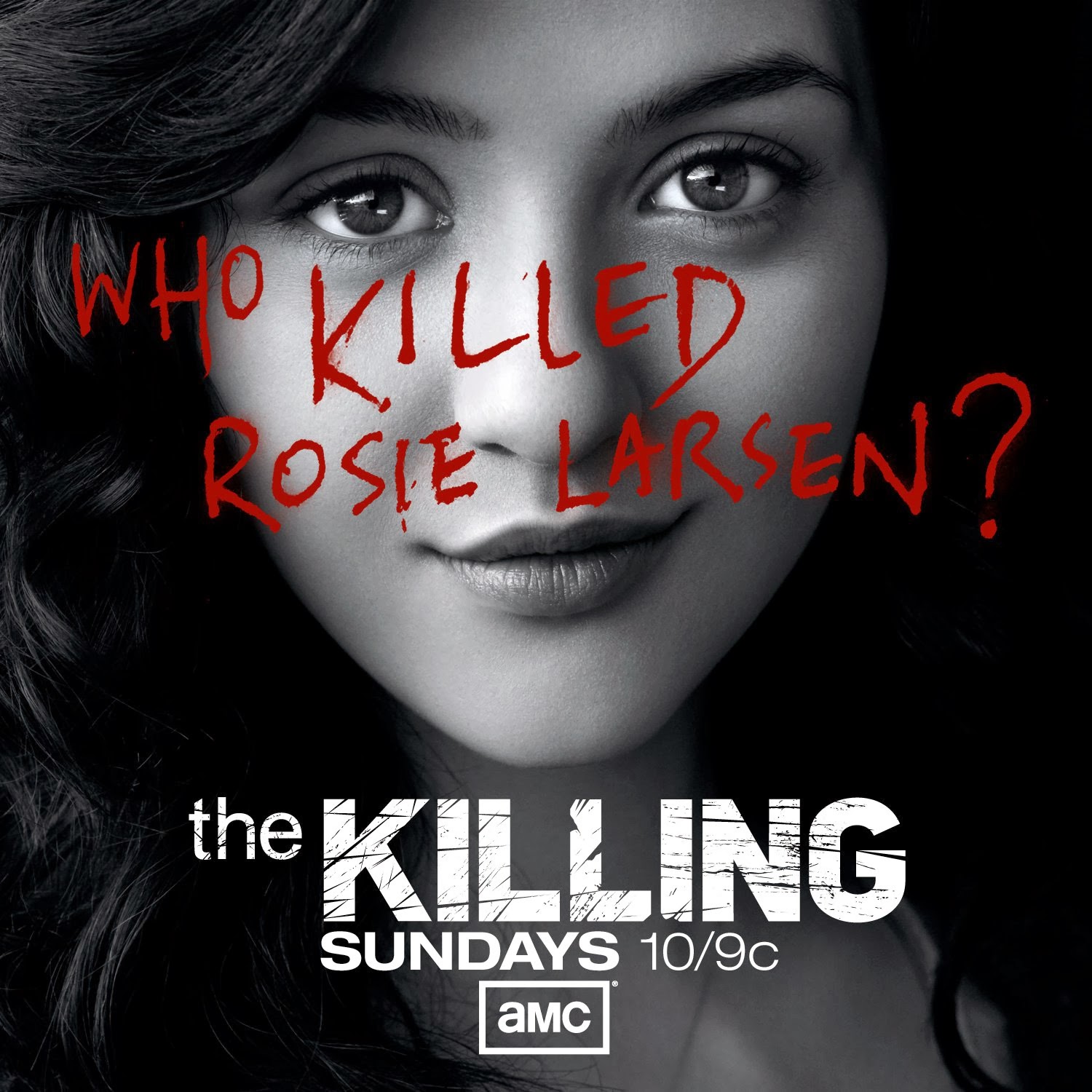
For those who are unfamiliar, The Killing is a cop drama following detectives Sarah Linden (Mireille Enos) and Stephen Holder (Joel Kinnaman). Based on the acclaimed Danish series Forbrydelsen, the idea was that, rather than solving a new crime each episode like on most cop dramas, the investigations would take longer. In the Danish season, each season was a new crime. This meant that the murders could be more complex and examined more thoroughly. For obvious reasons, The Killing gained a lot of comparisons to Twin Peaks—with the murder victim Rosie Larsen filling in for Twin Peaks’ famous Laura Palmer— and was similar in how it went about examining the crime. Ads for The Killing even featured the slogan "Who Killed Rosie Larsen," a clear Twin Peaks allusion. Although The Killing was obviously a significantly less weird show. While the investigation for the murderer was the main plot, the show wasn’t about solving a crime, it was about the death itself, and how Rosie’s death affected those around her. For example, we see how her family reacts. The parents of a murdered teen are a part of any such story in any drama—but by giving an entire season to let their emotions play out, the Larsens (played by Michelle Forbes and Brent Sexton) become more than just grieving parents. Yes, they feel sadness, but over time, that sadness evolves into desperation, fear, withdrawal, and anger, and we get a chance to see this complicated progression. But Rosie’s death has other consequences—for example, we see how the tragedy factors into and alters a local mayoral election. Perhaps most interestingly, we see how the murder takes a toll on the detectives. Obviously it is their job to solve the crime, but we see the emotional devastation that comes with being a homicide detective. Since it takes longer than an hour to solve the crime, Linden and Holder make mistakes, and have to deal with the consequences, and the performances of Enos and Kinnaman are reason alone to watch this series (for fans of Breaking Bad, Kinnaman’s character of Detective Holder is basically if Jesse Pinkman got out of the drug business, grew up, and became a cop).

A cop who would then grow up to become a Robocop.

But, I digress. As you can probably tell, however, I am a huge fan of the show and what it set out to accomplish. And at the start of the series, the critics agreed with me. The two-part pilot episode was some of the best two-hours of television in recent years—and received several accolades, including a Director’s Guild of America award for best direction of a drama series (director Patty Jenkins was only the third woman to ever win the award). Critics praised the performances in the show and the gritty, bleak tone it set. As the first season rolled along, The Killing was on its way to becoming AMC’s next big drama, garnered considerable Emmy buzz (and earned deserved acting nominations for Enos and Forbes), and was renewed for a second season. In the season 1 finale, Orpheus Descending, it looked as if everything in the Rosie Larsen case was going to be wrapped up. Linden and Holder made an arrest and seemed to have irrefutable evidence as to who the murderer was. The case was closed and ready to be reset for the next season.

And then, in the last four minutes of the episode, something happened. We found out that the evidence incriminating our supposed murderer has been tampered with and he’s not the killer after all.


The season ended on a cliffhanger—the case still unsolved and the big question of “Who Killed Rosie Larsen?” was still unanswered. Now, the show had already been picked up for a second season at this point. It wasn’t as if the murderer would never be revealed—it just meant they weren’t going to be revealed yet. And, yes, cliffhangers are rough, but they’re not particularly unheard of. There are numerous acclaimed series which end a season on a cliffhanger—it’s one of the oldest tricks in the book. And it didn’t exactly come out of left field—like many AMC dramas and murder mysteries, The Killing was no stranger to cliffhangers, and would almost always end an episode just as the detectives make a new discovery that completely changes the course of the investigation. When I watched the season 1 finale, I thought it was absolutely brilliant. Yes, I was screaming at my television screen, but that was the point. Showrunner Veena Sud knew exactly what she was doing. After a season, I was completely invested in the show and couldn’t bear the thought of having to wait a year to see how the rest of the story would unfold. But this is the mark of any great drama. You become so invested that you want to watch more to see where the show leads.

Fans and critics were staunchly divided in their opinions on Orpheus Descending. Many felt like I did—that it was a surprising end of the season, and were excited to see how the new developments would fuel the investigation in the second season. But, many fans were outraged, and in this age where everyone can make their opinion so readily known, the internet exploded. People took to twitter and facebook and tumblr and more to say how they hated the season 1 finale. But some took it farther. Some claimed that they felt betrayed by the show. Some called for Veena Sud to be fired. Some even went so far as to claim that they would never watch an AMC show again because the network had let this ending go through. By not answering the core question on all of the show’s advertising—“Who killed Rosie Larsen?”—many felt that the show had actively lied to its fans, and had not followed through on what it had promised.

The response was akin to other controversial TV finales—such as The Sopranos and Lost. Except, for those other series, they were series finales—and the frustration of fans came from the fact that their unanswered questions would forever be ambiguous. But, and I can’t stress this enough, this was a season finale, not a series finale. It’s true, the show had not answered the question of “Who killed Rosie Larsen,” but it still had more episodes to go. And no one involved in the show or at AMC had ever actually promised or even implied that the case would be solved in one season—it was just assumed by the audience. Now, to be fair, many pointed out that in the Danish series the season was based on, the case was solved in one season. But that season was 20 episodes long instead of 13, and the first and second halves had been aired a year apart (the way AMC aired the 5th season of Breaking Bad, for example). So, actually, this should have been a clue that the show might do just what it did. Showrunner Veena Sud said, “I am aware there’s been both excitement and frustration around the twist at the end of the season. Our goal was not to mislead but rather to do something different, to take the time the story needs to fully unfold.”

Detectives Linden and Holder investigate

Despite the negative response of some fans, there were still many viewers, like myself, who stood by the show and, in fact, liked the season 1 finale. But, then, the reviews came in. Now, I want to talk about the nature of critics in the world of art—I think they’re important. Critics facilitate a discussion of media. The best critics do not simply pass judgment, they provide commentary on the subject framed by their own opinions. The best critics are not always going to be the ones that you most agree with. For example, I disagreed with a lot of Roger Ebert’s reviews, but even if he loved a movie I hated, or vice versa, his reviews provided intelligent commentary and he was able to articulate his opinions well.  And reviews are important. Bad reviews can sting, but by the same token, a positive review is extremely validating, and can encourage people to see something they ordinarily would not have. So, my comments below are not attempting to speak out against critics. After all, this is an entertainment blog where I am going to be reviewing entertainment. Like a critic. It would be hypocritical for me to denounce the role of the critic. Especially if I discuss something that is really, really, really awful.

But there are some critics who thrive on writing negative reviews. And, with the mixed reaction from viewers for the season finale of The Killing, critics smelled blood in the water. Several reviewers published irresponsibly scathing reviews. Maureen Ryan of The Huffington Post was notoriously. As a critic, I hold Maureen Ryan in very low regard and find myself disagreeing with her more than I agree with her, and had felt this way before her review of The Killing’s finale. In her review, she came across as actually offended by the show—as if the show had done her some personal harm in some way. But it didn’t—it just ended its season on a cliffhanger.

Mitch and Stan Larsen-- the parents of the fictional victim of The Killing

The second season did what everyone wanted it to do: it solved the murder of Rosie Larsen. But at this point, nobody was watching it. The Killing became known for its critical backlash as opposed to its distinct mood and out-of-this-world performances. Critics went into the second season ready to pounce, ready to criticize. One of the number one online communities for discussion of media—The A.V. Club—was particularly harsh. While I typically love the reviews on the website, reviewer Brandon Nowalk, who was assigned to season 2 of The Killing, appeared to go into the season with an absolute disgust for the show—a place from which a reviewer should never approach the media that they are reviewing (the site, by the way, also featured a harsh condemnation for Orpheus Descending, which it rated a D+). For me, the actual case of who killed Rosie Larsen was solved the best way that it could be. The identity of the murderer tied in the multiple storylines of the series, and was unexpected without coming out of left field. But, like the rest of the season, it was panned by most reviewers for reasons I truly cannot understand, and which never seemed to me to be fully articulated. Due to the low ratings of the show, AMC had to cancel it, a decision which received cheers mostly from viewers who had long since stopped watching the show.

But, after the news of the cancellation, another surprising announcement was made—Netflix was in talks to pick up the series for another season. See, while the show did poorly in the United States, it was beloved abroad, by viewers who had not been privy to the backlash of the first season finale. Eventually, AMC ended up picking up the show for a third season, making a deal with Netflix that they could release the season online in Europe as it aired in the U.S. The third season was an exciting chance for the show to start anew—as they were solving a completely new case, only the two main characters (the detectives) were carried over to this new season. This was a new case, and a new chance for the show. As always, the gritty atmosphere of the show was spot on, and the performances were incredible. Specifically, a young actress named Bex Taylor-Klaus knocked it out of the park as a gritty tomboy named Bullet. And the series landed a big name in Peter Sarsgaard—a fan of the show who reportedly approached the producers himself asking if he could be cast—who portrayed an inmate on death row. Sure enough, critics began giving it high praise—many adopting a tone of surprise while doing so.


The fantastic Bex Taylor-Klaus as Bullet in Season 3

But audiences who had long written off the show were not willing to watch it, and articles praising the season were treated to a slew of comments from disgruntled former fans who, rather than give the show a try in light of its renewed critical acclaim, responded that the critic must be wrong and there was no way the show could possibly be good. The show once again had dismal ratings.

While, for me, the third season takes a while to get going, the end of the season was one of the most exciting I’ve seen in a while. Two of the episodes from this season—“Reckoning” (directed by Silence of the Lambs director Jonathan Demme) and “Six Minutes”—were some of the best hours of television that I’ve ever seen, and could have competed with the episodes of AMC’s magnum opus Breaking Bad. Even if you’re not sold on my defense of the show as a whole and don’t intend to watch it, I really encourage you to watch “Six Minutes.” While it obviously will carry more of a punch if you’ve seen the season and have gotten to know the characters, the episode is mostly standalone, and I think that it would be impressive enough on its own (even the AV Club, which to be fair had generally nice things to say about the third season, assigned the episode a rare A rating). The episode follows Sarsgaard’s character—the inmate Ray Seward (who is in jail at the start of the season and is not a suspect in the case that the third season focuses on), in the 24 hours before his pending execution. By his request, he will be hanged—a decision he now regrets as he learned that if the noose does not immediately kill him, he could stay alive for up to six minutes before suffocating (hence the title). The head detective in charge of putting him in prison—Enos’ detective Linden—now has some doubts as to his guilt and is trying to obtain a stay of execution for him. It’s a tense, heartfelt, and gripping episode which reads like a fantastic short film. Watch it—I don’t think you’ll be disappointed. And I’m seriously hoping the episode somehow garners some awards for writing and directing at the upcoming Emmy awards. Although this is unlikely, they would be very much deserved.


Peter Sarsgaard in the episode "Six Minutes"

But, back to the series as a whole, I have one major question: if the show had really been as bad as people say it was, then why would it have experienced the backlash that it did? If people hated the show, then why would they have been so shocked and devastated when the case was not immediately solved? If they were not invested in these wonderful, well-rounded characters then how could the finale have garnered such a strong reaction? It makes me think of the hatred of the films of M. Night Shyamalan. If Shyamalan were just a hack director with no talent (and I’m not necessarily saying he’s not) then his films would just be ignored and acknowledged as bad, but innocuous. The reason that Shyamalan’s films are so wonderfully celebrated as being awful is because of his initial success. If not for The Sixth Sense, no one would care about how bad The Happening was. The finale let people down, and that’s fine. I disagree and thought it was brilliant, but I’m not going to discount the fact that people didn’t enjoy the finale and do not intend to put down any other viewer's opinion. But just as we shouldn’t let Shyamalan’s many, many, many, many, many, many failures blemish the fact that The Sixth Sense is a pretty brilliant film, the first season finale should not define The Killing in the way that it truly has. While it has generally been acknowledged that there are times when a show “jumps the shark,” I cannot think of any other show where a single episode so completely reversed any goodwill that critics had towards the series. It’s a true anomaly.

Brandon Jay McLaren as one of the initial suspects in Season 1

This whole incident speaks to the power of a critic. I think that critics are important, as discussion of the arts is always important, and reviews encourage that. But critics hold immense power—a poor review can kill a show. Just as a positive review can make a show. This becomes dangerous when a critic’s response so clearly dictate’s a supposedly autonomous audience’s response. Which is why I encourage you to not just take my word for it—watch The Killing. And if you hate it that’s fine. But watch it with an open mind.

The show is, actually, not dead yet. Someone at Netflix clearly loves this show, as Netflix has picked the show up for a fourth and final season, marking it the second time the show has been canceled and then renewed. Indeed, The Killing seems to be a show that can’t be killed. And the two main actors from the series-- Enos and Kinnaman-- have been seeing a tremendous amount of success in the show's wake, which is well-deserved considering their incredible performances. I for one am excited for what the fourth season will bring, and am looking forward to more episodes to spend with Linden and Holder (seriously, their friendship and partnership is really important to me).  My hope is that, with the show existing on Netflix, it will allow for newer audiences to experience the show without the swarm of hatred surrounding it. Perhaps history will be kind to The Killing. I certainly hope so.

Linden and Holder interview a suspect in undoubtedly the brightest-lit shot in the series. Yeah, that's Kacey Rohl from Hannibal. Seriously, the cast is great and you should watch this show.